Understanding Network Fingerprinting via WebRTC

WebRTC is widely known for enabling real-time communication in browsers, but it also plays a significant role in network fingerprinting. By exposing detailed network information during connection setup, WebRTC allows websites to collect data that can be used to identify and track users.
Understanding how WebRTC contributes to network fingerprinting is important because it operates at a deeper level than traditional tracking methods. Even when other signals are masked, WebRTC can reveal underlying network characteristics. This guide explains how WebRTC is used for fingerprinting and why it matters.
What Is Network Fingerprinting via WebRTC?
Network fingerprinting via WebRTC refers to the process of identifying a user based on network-related data exposed through WebRTC APIs.
This includes IP addresses, connection types, and routing behavior. These signals can be combined to create a unique profile of a device’s network environment.
Unlike cookies or simple identifiers, this type of fingerprinting is harder to control because it relies on underlying network characteristics.
The Core Principle Behind Network Fingerprinting
The core principle behind network fingerprinting is uniqueness through network data.
Every device connects to the internet through a specific combination of IP addresses, interfaces, and routing paths.
WebRTC exposes these details during connection setup, allowing websites to analyze and compare them.
This creates a fingerprint that can persist across sessions.
How WebRTC Enables Network Fingerprinting
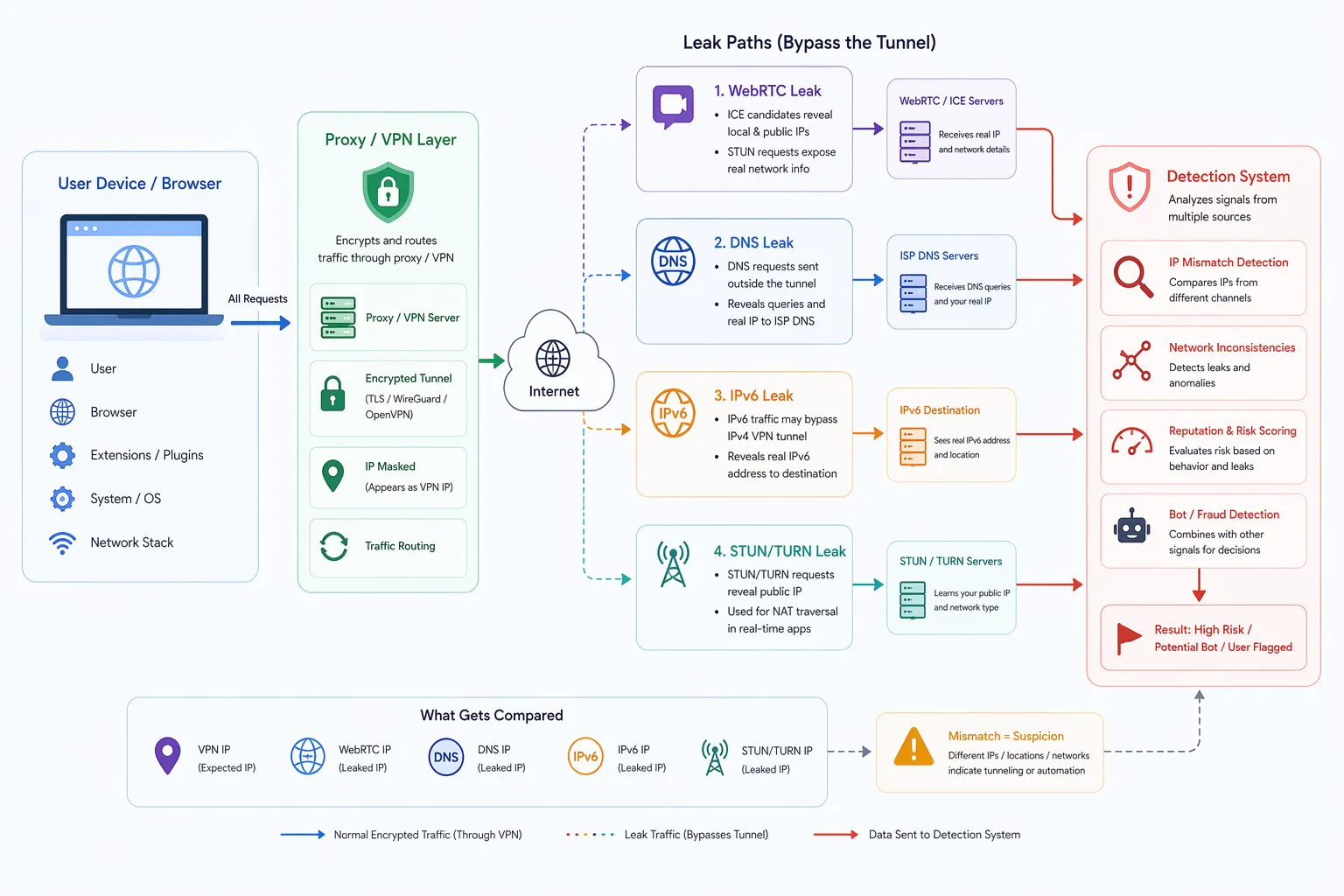
WebRTC exposes multiple layers of network information during its operation.
ICE Candidate Collection
When a WebRTC connection is initiated, the browser gathers ICE candidates.
These candidates include local IP addresses, public IP addresses, and relay server addresses.
This process reveals multiple network interfaces and routing options.
STUN Server Interaction
STUN servers are used to determine the public IP address of a device.
By querying a STUN server, the browser learns how it appears externally on the internet.
This information can be accessed and used for fingerprinting.
Multiple Network Interfaces
Devices often have multiple network interfaces, such as Wi-Fi, Ethernet, or mobile data.
WebRTC can expose information about these interfaces, adding more detail to the fingerprint.
Connection Behavior
The way a device establishes connections can also be analyzed.
This includes timing, candidate selection, and fallback behavior.
These patterns contribute to the uniqueness of the fingerprint.
Why WebRTC Fingerprinting Matters
WebRTC fingerprinting matters because it provides detailed network-level insights that are difficult to mask.
Even if other identifiers are hidden, network characteristics can still reveal information about the user.
This makes it a valuable tool for tracking and detection systems.
It is commonly used in security, fraud prevention, and analytics.
WebRTC Fingerprinting and Bot Detection
Bot detection systems use WebRTC fingerprinting to identify inconsistencies.
If the network data exposed through WebRTC does not match the expected routing or location, it can indicate automation.
For example, a mismatch between public IP and local network characteristics can raise suspicion.
This signal is often combined with other detection methods.
WebRTC Fingerprinting vs Traditional Fingerprinting
Traditional fingerprinting focuses on browser and device characteristics, such as screen resolution and installed fonts.
WebRTC fingerprinting adds a network layer to this process.
By combining both approaches, systems can create more robust and unique identifiers.
This increases detection accuracy.
Limitations of WebRTC Fingerprinting
Despite its effectiveness, WebRTC fingerprinting has limitations.
Some browsers restrict access to certain network information.
Users can disable WebRTC or configure it to limit exposure.
Additionally, network conditions can change, affecting consistency.
These limitations require fingerprinting to be combined with other signals.
WebRTC Fingerprinting vs Other Network Signals
WebRTC fingerprinting is often used alongside other network-based signals such as DNS behavior and IP reputation.
While each signal provides insight, combining them creates a more complete picture.
WebRTC is particularly valuable because it exposes real-time connection data.
WebRTC Fingerprinting vs Real-Device Environments
A key distinction in modern detection is the difference between simulated setups and real-device environments.
WebRTC fingerprinting can reveal inconsistencies in environments where network routing is artificially modified.
Real-device approaches operate on actual hardware and network conditions where signals naturally align. Tools like Appilot follow this approach by running automation on real Android devices, where IP exposure, connection behavior, and network interfaces reflect real-world usage.
This reduces mismatches that detection systems rely on.
When WebRTC Fingerprinting Is Most Critical
WebRTC fingerprinting is most critical in scenarios where network identity plays a key role.
This includes authentication systems, geo-restricted platforms, and fraud detection systems.
In these contexts, network-level data provides strong indicators of authenticity.
Understanding this helps in managing risk.
Frequently Asked Questions
Q: What is WebRTC network fingerprinting?
It is the use of WebRTC data to identify users based on network characteristics.
Q: What information does WebRTC expose?
Local IP, public IP, network interfaces, and connection behavior.
Q: Why is WebRTC used for fingerprinting?
Because it provides detailed and unique network data.
Q: Can WebRTC fingerprinting be prevented?
It can be reduced by limiting or disabling WebRTC.
Q: Is it used alone for detection?
No, it is combined with other signals.
Q: How do real-device solutions compare?
Real-device solutions like Appilot maintain consistent network behavior, reducing mismatches detected through WebRTC.
Key Takeaways
WebRTC network fingerprinting uses IP data, ICE candidates, and connection behavior to create a unique profile of a device’s network environment. By exposing detailed network information, it allows websites to identify and track users beyond traditional methods. While powerful, it has limitations and is often combined with other signals for better accuracy. Understanding how WebRTC contributes to fingerprinting is essential for managing privacy and detection risks.