What Are ISP Proxies? (Static Residential Proxies Explained)

When working with proxies, most discussions focus on residential, datacenter, or mobile IPs, but there is another category that combines characteristics of both. ISP proxies, also known as static residential proxies, offer a unique balance between stability and trust.
Understanding ISP proxies is important because they solve a key limitation in proxy usage: maintaining a consistent identity while still appearing legitimate. This guide explains what ISP proxies are, how they work, and where they fit in browser automation.
What Are ISP Proxies?
ISP proxies are IP addresses that are assigned by internet service providers but hosted on datacenter infrastructure. This means they appear as residential IPs to websites while offering the performance and stability of servers.
Unlike traditional residential proxies, which are tied to real user devices, ISP proxies are static and remain assigned to a single user. This makes them ideal for maintaining long-term sessions.
Because they originate from ISP ranges, websites often treat them as legitimate user traffic.
The Core Principle Behind ISP Proxies
The core principle behind ISP proxies is combining trust with stability. Residential proxies provide authenticity but can change frequently, while datacenter proxies offer stability but are easier to detect.
ISP proxies bridge this gap by providing IPs that look residential but behave like datacenter connections. This allows for consistent sessions without sacrificing credibility.
This balance makes them particularly useful in scenarios that require both reliability and realism.
How ISP Proxies Work
ISP proxies work by allocating IP addresses from ISP ranges and hosting them on dedicated servers.
Static IP Assignment
Unlike rotating residential or mobile proxies, ISP proxies provide static IPs that remain consistent over time. This allows sessions to maintain the same identity across multiple interactions.
This stability is critical for workflows that depend on persistent sessions.
Datacenter Hosting with Residential Appearance
Although ISP proxies are hosted in datacenters, their IP addresses are registered under ISPs. This makes them appear as residential traffic to websites.
From a technical perspective, the network routing resembles datacenter performance, while the IP classification reflects residential origin.
Consistent Network Behavior
Because ISP proxies are not shared among multiple users like mobile proxies, they offer consistent performance and lower latency.
This makes them suitable for tasks that require predictable behavior.
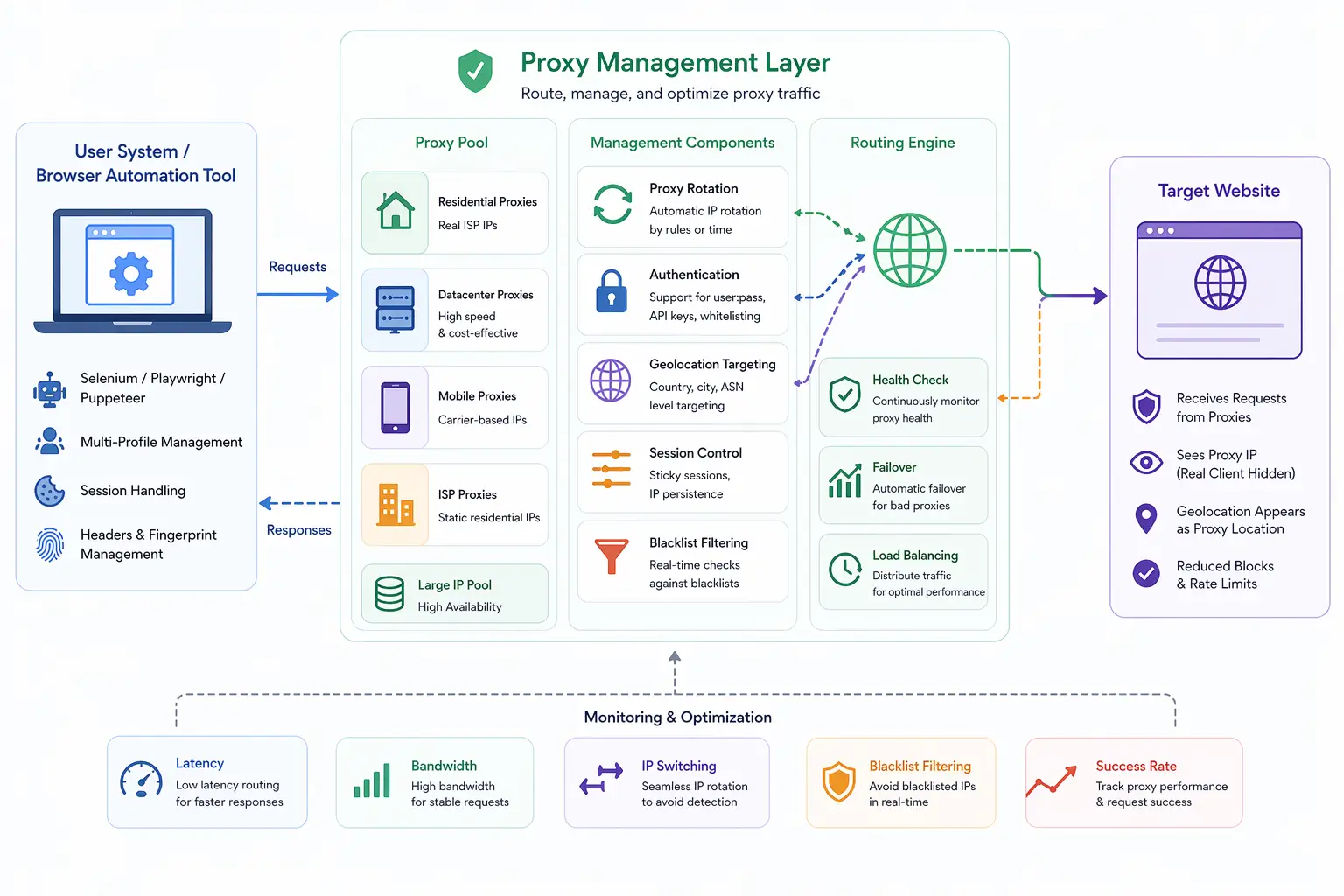
Why ISP Proxies Matter in Automation
ISP proxies are valuable in automation because they provide a stable identity that can be maintained over time.
In workflows where repeated interactions are required, such as account management or session persistence, having a consistent IP is critical. Frequent IP changes can trigger detection systems, making static proxies more reliable.
At the same time, their residential classification reduces the likelihood of being flagged compared to datacenter proxies.
This combination makes ISP proxies a strong choice for long-term automation setups.
ISP Proxies vs Residential Proxies
ISP proxies and residential proxies both use IP addresses from ISP ranges, but they differ in how those IPs are assigned and used.
Residential proxies are tied to real devices and may rotate frequently, while ISP proxies are static and dedicated to a single user.
Residential proxies offer higher authenticity due to real device usage, while ISP proxies provide greater stability and control.
Choosing between them depends on whether variability or consistency is more important.
ISP Proxies vs Datacenter Proxies
The difference between ISP and datacenter proxies lies in perception and trust.
Datacenter proxies are fast and scalable but are often flagged due to their origin. ISP proxies, while also hosted in datacenters, appear as residential IPs, making them harder to detect.
This gives ISP proxies an advantage in environments where detection systems are sensitive to IP classification.
Limitations of ISP Proxies
Despite their advantages, ISP proxies have limitations.
One limitation is cost. ISP proxies are typically more expensive than datacenter proxies due to their residential classification.
Another limitation is availability. ISP IP ranges are more limited, which can affect scalability.
There is also the issue of detection over time. Because ISP proxies are static, repeated activity from the same IP can still be flagged if behavior appears suspicious.
These limitations highlight the importance of combining proxies with other techniques.
ISP Proxies and Fingerprinting
Like all proxies, ISP proxies only affect network identity. They do not change browser fingerprinting signals.
If multiple sessions share the same fingerprint, they can still be linked even when using different ISP proxies.
This means that proxies must be aligned with consistent and realistic browser configurations.
ISP Proxies vs Real-Device Environments
A key distinction in modern detection systems is the difference between network-level identity and full environment realism.
ISP proxies provide a stable and trusted IP, but they do not affect how the browser or device behaves. This can lead to inconsistencies if other signals do not align.
Real-device approaches operate on actual hardware, where network, browser, and device signals naturally match. Tools like Appilot follow this approach by running automation on real Android devices, combining stable network identity with consistent device behavior.
This creates a more complete solution compared to relying on proxies alone.
When to Use ISP Proxies
ISP proxies are best used in scenarios where maintaining a consistent identity is critical.
They are commonly used in account management, long-term session workflows, and environments where frequent IP changes are undesirable.
Their stability makes them ideal for tasks that require persistence, while their residential classification reduces detection risk.
Frequently Asked Questions
Q: What is an ISP proxy?
It is a proxy that uses a residential IP from an ISP but is hosted on datacenter infrastructure.
Q: Why are ISP proxies called static residential proxies?
Because they provide residential IPs that remain fixed over time.
Q: Are ISP proxies better than residential proxies?
They offer more stability but less variability compared to residential proxies.
Q: Are ISP proxies detectable?
They are harder to detect than datacenter proxies but can still be flagged with repeated activity.
Q: Do ISP proxies prevent fingerprinting?
No, they only affect IP addresses. Fingerprinting must be handled separately.
Q: How do real-device solutions compare?
Real-device solutions like Appilot align network, browser, and hardware signals naturally, while ISP proxies only manage network identity.
Key Takeaways
ISP proxies, also known as static residential proxies, combine the trust of residential IPs with the stability of datacenter hosting. They provide consistent IP addresses that are ideal for long-term sessions and account-based workflows. While they offer advantages in reliability and detection resistance, they do not address browser fingerprinting or deeper system-level signals. Understanding their role and limitations is essential for building effective automation environments.