What Is Bot Detection? How Websites Identify Automation

As browser automation becomes more advanced, websites are also becoming more sophisticated in identifying non-human activity. This process is known as bot detection. It is designed to distinguish real users from automated systems based on patterns, signals, and behavior.
Understanding bot detection is important because it explains why automation often fails when not configured properly. Websites do not rely on a single signal to detect bots; instead, they analyze multiple layers of data to build a complete picture. This guide explains how bot detection works and the key methods used to identify automation.
What Is Bot Detection?
Bot detection is the process of identifying whether a visitor interacting with a website is a human or an automated system. Websites use various techniques to analyze incoming traffic and classify behavior.
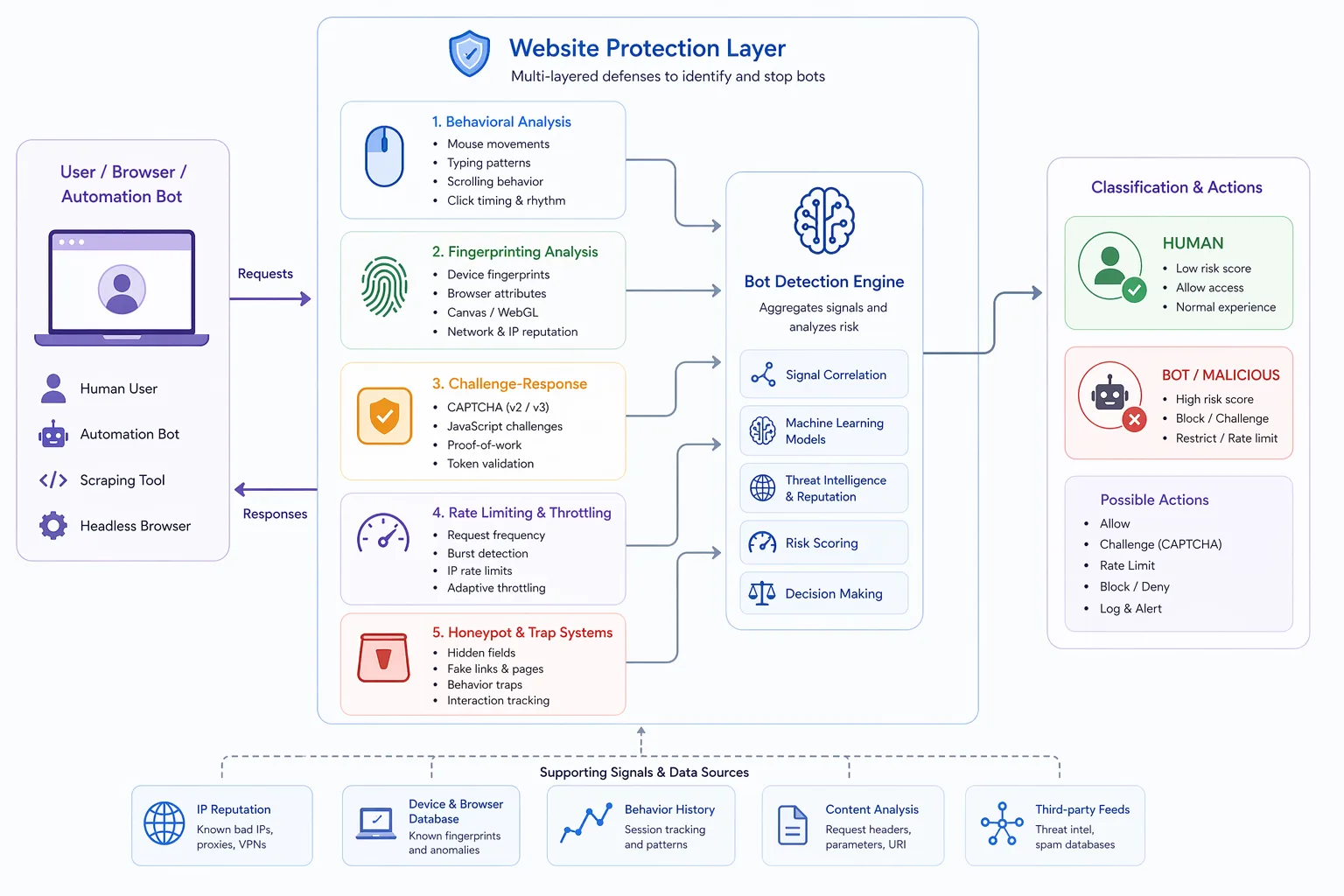
This classification determines how the system responds. Human users are allowed to proceed normally, while suspected bots may face restrictions such as captchas, rate limits, or blocks.
Bot detection is widely used in platforms that need to protect resources, prevent abuse, and maintain data integrity.
The Core Principle Behind Bot Detection
The core principle behind bot detection is pattern recognition. Human behavior tends to be irregular and context-driven, while automated systems often produce consistent and predictable patterns.
By analyzing differences in behavior, environment, and technical signals, websites can identify anomalies that indicate automation.
Detection systems combine multiple signals to increase accuracy rather than relying on a single factor.
How Bot Detection Works
Bot detection works by collecting and analyzing data from different layers of the interaction.
Browser Fingerprinting Analysis
Websites collect detailed information about the browser and device, including screen resolution, hardware characteristics, and rendering outputs.
This information is used to create a fingerprint that helps identify and track users. Automated environments often produce fingerprints that differ from real devices.
Behavioral Analysis
Behavioral patterns are a key part of bot detection. Websites monitor how users interact with pages, including mouse movements, typing patterns, and timing between actions.
Humans exhibit natural variability, while bots often follow predictable sequences.
Network and IP Analysis
Websites analyze IP addresses, geolocation, and network patterns. Suspicious activity such as high request volumes or inconsistent locations can trigger detection.
IP reputation also plays a role, as certain ranges are associated with automated traffic.
JavaScript and API Checks
Detection systems use JavaScript to probe browser properties and identify automation signals. This includes checking for modified APIs, missing features, or unusual values.
These checks help identify environments that have been altered for automation.
Why Bot Detection Exists
Bot detection exists to protect websites from abuse and ensure fair usage.
Automated systems can be used for scraping, account creation, or other activities that may disrupt services. Detection systems help prevent these actions by identifying and restricting bots.
They also help maintain data accuracy and user experience by ensuring that interactions come from real users.
Common Bot Detection Signals
Websites rely on a combination of signals to identify bots.
Consistency is a major factor. Repeated actions performed at regular intervals can indicate automation.
Inconsistencies between signals, such as mismatched geolocation and browser settings, can also raise suspicion.
Unusual interaction patterns, such as instant responses or lack of natural delays, are another indicator.
These signals are analyzed together rather than individually.
Limitations of Bot Detection
While bot detection systems are advanced, they are not perfect.
False positives can occur, where legitimate users are incorrectly flagged as bots. This can lead to unnecessary restrictions.
There is also the challenge of evolving techniques. As automation tools improve, detection systems must continuously adapt.
This creates an ongoing cycle of improvement on both sides.
Bot Detection vs Simple Blocking
Bot detection is more advanced than simple IP blocking.
Instead of blocking based on a single factor, detection systems evaluate multiple signals to make decisions. This allows for more accurate identification but also increases complexity.
Modern systems use scoring models rather than binary decisions, assigning risk levels to each session.
Bot Detection vs Anti-Detection Techniques
Bot detection and anti-detection techniques are two sides of the same problem.
Detection systems aim to identify automation, while anti-detection approaches attempt to mimic real user behavior and environments.
Understanding both perspectives is important for building effective systems.
Bot Detection vs Real-Device Environments
A key distinction in modern automation is the difference between simulated environments and real-device environments.
Detection systems are designed to identify inconsistencies in simulated setups. Even well-configured environments can produce subtle signals that reveal automation.
Real-device approaches operate on actual hardware, where browser behavior, network patterns, and device signals naturally align. Tools like Appilot follow this approach by running automation on real Android devices, reducing the need to mask or simulate signals.
This creates a more consistent and realistic environment.
When Bot Detection Is Most Strict
Bot detection is most strict in environments where security and resource protection are critical.
This includes platforms that handle sensitive data, high-value transactions, or large-scale interactions.
In these scenarios, detection systems use more advanced techniques and stricter thresholds.
Understanding this helps in adapting strategies accordingly.
Frequently Asked Questions
Q: What is bot detection?
It is the process of identifying whether a user is human or an automated system.
Q: How do websites detect bots?
By analyzing fingerprints, behavior, network data, and browser properties.
Q: Can bots avoid detection completely?
No, they can reduce detection risk but cannot eliminate it entirely.
Q: What happens when a bot is detected?
It may face captchas, rate limits, or be blocked.
Q: Is bot detection always accurate?
No, false positives can occur.
Q: How do real-device solutions compare?
Real-device solutions like Appilot align all signals naturally, making environments more consistent compared to simulated setups.
Key Takeaways
Bot detection is the process of identifying automated activity by analyzing multiple signals such as browser fingerprints, behavior patterns, network data, and JavaScript checks. It relies on detecting inconsistencies and patterns that differ from real user behavior. While detection systems are highly advanced, they are not perfect and must continuously evolve to keep up with new automation techniques. Understanding how bot detection works is essential for building reliable and realistic automation systems.