What Is a Proxy Pool? Managing Multiple IP Addresses

As automation scales, using a single proxy quickly becomes insufficient. Sending large volumes of requests through one IP leads to rate limits, detection, and blocked sessions. To handle this, systems rely on proxy pools, which allow multiple IP addresses to be used dynamically.
Understanding proxy pools is important because they form the foundation of scalable automation. They enable distribution of traffic, separation of identities, and better control over network behavior. This guide explains what a proxy pool is, how it works, and how it is used in practice.
What Is a Proxy Pool?
A proxy pool is a collection of multiple proxy IP addresses that can be used interchangeably or strategically within an automation system. Instead of relying on a single proxy, requests are routed through a pool of available IPs.
This allows traffic to be distributed across different identities, reducing the likelihood of detection or blocking.
Proxy pools are commonly used in automation, data collection, and multi-account systems where multiple sessions need to operate independently.
The Core Principle Behind Proxy Pools
The core principle behind proxy pools is distribution and redundancy. By spreading requests across multiple IPs, the system avoids overloading any single proxy.
This distribution reduces the visibility of patterns and makes it harder for detection systems to associate activity with a single identity.
At the same time, having multiple proxies provides redundancy. If one proxy fails or gets blocked, others can take its place.
How Proxy Pools Work
Proxy pools work by managing a set of available proxies and assigning them to requests or sessions based on defined rules.
Pool Creation and Management
A proxy pool is created by adding multiple proxy IPs into a centralized system. These proxies can come from different sources, such as residential, datacenter, mobile, or ISP providers.
The system keeps track of each proxy’s status, availability, and performance.
Proxy Assignment
When a request is made, the system selects a proxy from the pool based on a specific strategy. This could be random selection, round-robin distribution, or performance-based selection.
The chosen proxy is then used to route the request.
Health Monitoring and Replacement
Proxy pools often include monitoring mechanisms to detect failures or blocked IPs. If a proxy becomes unreliable, it can be removed from the pool and replaced with a new one.
This ensures that the pool remains functional and effective over time.
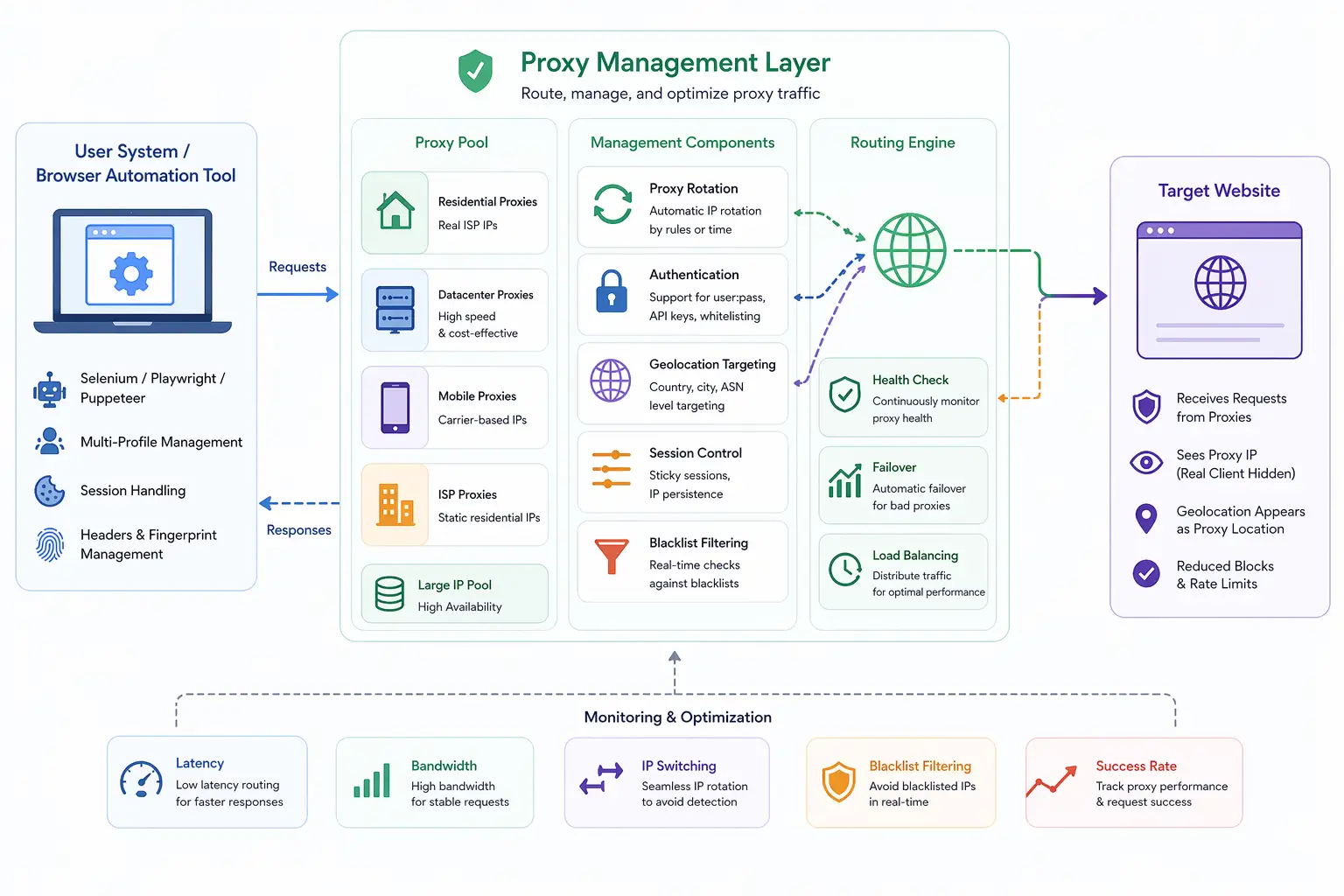
Why Proxy Pools Matter in Automation
Proxy pools are essential for scaling automation because they allow multiple sessions to operate without being linked.
Without a proxy pool, all traffic would originate from a single IP, making it easy for websites to detect unusual activity. By distributing requests across multiple IPs, proxy pools reduce this risk.
They also improve reliability by providing fallback options when individual proxies fail.
This makes proxy pools a critical component in large-scale automation systems.
Proxy Pools and Rotation
Proxy pools are closely related to proxy rotation.
Rotation is the process of switching between IPs, while the pool provides the set of available IPs to rotate through. Without a pool, rotation would not be possible.
Different rotation strategies can be applied within a proxy pool, depending on the requirements of the workflow.
Understanding this relationship helps in designing effective systems.
Common Strategies for Using Proxy Pools
There are several strategies for using proxy pools effectively.
Some systems assign one proxy per session to maintain consistency, while others rotate proxies frequently to distribute load.
Advanced setups use intelligent selection based on performance, location, or success rates.
The choice of strategy depends on the balance between stability and variability.
Limitations of Proxy Pools
While proxy pools offer scalability, they also have limitations.
One limitation is management complexity. Maintaining a large pool requires monitoring, updating, and replacing proxies regularly.
Another limitation is consistency. If proxies are rotated without aligning other signals, sessions can still be linked.
There is also the issue of quality. Low-quality proxies in the pool can reduce overall performance and increase detection risk.
These limitations highlight the importance of proper configuration.
Proxy Pools and Fingerprinting
Proxy pools only manage network identity. They do not affect browser fingerprinting signals.
If multiple sessions use different IPs from a pool but share the same fingerprint, they can still be linked by detection systems.
This means that proxy pools must be combined with consistent and realistic browser configurations.
Proxy Pools vs Static Proxy Usage
Using a proxy pool is different from using a single static proxy.
Static proxies provide consistency but are limited in scalability. Proxy pools provide flexibility and distribution but require more management.
Choosing between them depends on the specific needs of the workflow.
Proxy Pools vs Real-Device Environments
A key distinction in modern detection systems is the difference between managing IPs and managing full environments.
Proxy pools handle network-level identity by distributing requests across multiple IPs. However, they do not affect browser or device-level behavior.
Real-device approaches operate on actual hardware, where network, browser, and system signals naturally align. Tools like Appilot follow this approach by running automation on real Android devices, reducing reliance on large proxy pools by ensuring consistent and realistic environments.
This simplifies identity management compared to complex proxy setups.
When to Use Proxy Pools
Proxy pools are best used in scenarios where scalability and distribution are required.
They are commonly used in large-scale automation, data collection, and multi-account systems where multiple identities must operate simultaneously.
However, they should be used alongside other techniques to ensure consistency across all signals.
Frequently Asked Questions
Q: What is a proxy pool?
It is a collection of multiple proxy IPs used to distribute requests across different identities.
Q: Why are proxy pools used?
To scale automation, reduce detection risk, and improve reliability.
Q: How does a proxy pool work?
It assigns proxies to requests based on strategies such as rotation or performance.
Q: Do proxy pools prevent fingerprinting?
No, they only manage IP addresses. Fingerprinting must be handled separately.
Q: What is the difference between proxy rotation and a proxy pool?
A pool is the set of IPs, while rotation is the process of switching between them.
Q: How do real-device solutions compare?
Real-device solutions like Appilot reduce reliance on large proxy pools by providing consistent environments across network and device layers.
Key Takeaways
A proxy pool is a collection of multiple proxy IPs used to distribute traffic and manage network identity in automation systems. It enables scalability, reduces detection risk, and improves reliability by providing redundancy. While proxy pools are essential for handling large volumes of requests, they must be combined with consistent browser and device-level signals to be effective. Proper management and strategy are key to maximizing their benefits.