What Is Puppeteer Stealth? Anti-Detection for Automation
Browser automation has become a core part of modern development, testing, and data workflows, but one major challenge remains: detection. Many websites can identify automated browsers by analyzing subtle differences in behavior and configuration. This is where Puppeteer Stealth comes into play.
Understanding Puppeteer Stealth is important because it represents one of the most widely used approaches to reducing detection in automation environments. It works by masking common automation signals, but it also has limitations that are often overlooked. This guide explains what Puppeteer Stealth is, how it works, and where it fits in modern detection systems.
What Is Puppeteer Stealth?
Puppeteer Stealth is a plugin built on top of Puppeteer that modifies browser behavior to make automated environments appear more like real user-driven browsers. It is designed to hide indicators that reveal automation.
Puppeteer itself is a Node.js library that controls Chromium-based browsers. By default, Puppeteer exposes several signals that can be detected by websites. The Stealth plugin addresses these by applying a set of patches.
These patches target known detection methods and aim to reduce the differences between automated and standard browser environments.
The Core Principle Behind Puppeteer Stealth
The core principle behind Puppeteer Stealth is masking known detection signals. Automated browsers often expose properties that differ from real browsers, and detection systems use these differences to identify them.
Puppeteer Stealth works by modifying these properties so that they match expected values. This includes adjusting JavaScript APIs, browser features, and behavior patterns.
The goal is to make the automation environment indistinguishable from a regular browser session, at least at the surface level.
How Puppeteer Stealth Works
Puppeteer Stealth operates by applying multiple patches to the browser environment at runtime.
Removing Automation Indicators
One of the first steps is removing or modifying indicators that reveal automation. For example, certain properties in the navigator object may indicate that the browser is controlled programmatically.
The plugin overrides these properties so that they return values consistent with standard browsers.
Patching Headless Behavior
Headless browsers behave differently from headful browsers, which makes them easier to detect. Puppeteer Stealth patches these differences by enabling missing features and adjusting behavior.
This helps align headless environments with the expectations of real user browsers.
Modifying Browser APIs
Puppeteer Stealth modifies various JavaScript APIs to ensure that their outputs match realistic values. This includes properties related to plugins, languages, and permissions.
These changes reduce inconsistencies that detection systems rely on.
Adjusting Rendering Signals
Some versions of Puppeteer Stealth also address rendering-based signals such as canvas and WebGL. This involves modifying how rendering data is returned.
While this improves realism, it does not fully replicate real hardware behavior.
Why Puppeteer Stealth Matters
Puppeteer Stealth matters because it reduces the most obvious signals that expose automation. Without it, automated browsers can be easily identified through simple checks.
In automation workflows, it improves reliability by making environments appear more like real user sessions. This is particularly useful in scenarios where detection systems are present.
However, Puppeteer Stealth primarily addresses known detection methods and does not cover all possible signals.
Limitations of Puppeteer Stealth
While Puppeteer Stealth is useful, it has several limitations.
One limitation is that it relies on patching known issues. As detection systems evolve, new signals may emerge that are not covered by the plugin.
Another limitation is that it operates at the browser level. It does not modify deeper signals such as hardware behavior or system-level interactions.
There is also the challenge of consistency. Patching multiple aspects of the browser can introduce subtle mismatches that detection systems can identify.
These limitations mean that Puppeteer Stealth is not a complete solution.
Puppeteer Stealth vs Stealth Plugins
Puppeteer Stealth can be considered a specialized type of stealth plugin designed specifically for Puppeteer environments.
While general stealth plugins work across different frameworks, Puppeteer Stealth is tailored to address issues specific to Puppeteer and Chromium-based browsers.
This makes it more effective within its ecosystem but limited outside of it.
Puppeteer Stealth vs Antidetect Browsers
Puppeteer Stealth and antidetect browsers serve different purposes.
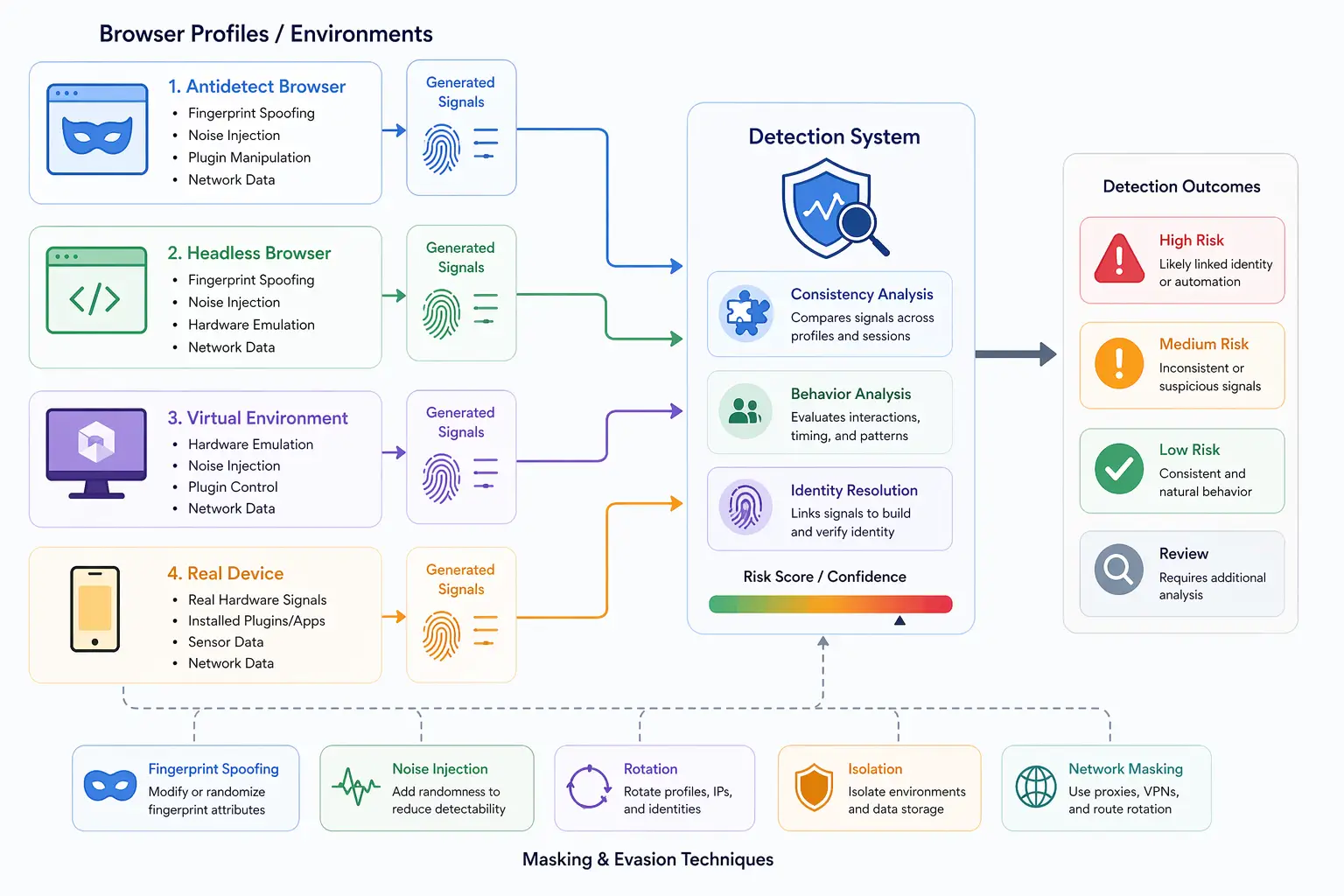
Puppeteer Stealth focuses on masking automation signals within a single browser instance, while antidetect browsers provide profile management and fingerprint customization.
In many workflows, these approaches can be combined, but each has its own limitations.
Puppeteer Stealth vs Real-Device Environments
A key distinction in modern detection systems is the difference between masking automation signals and using real environments.
Puppeteer Stealth attempts to hide automation artifacts, but it does not change the underlying system behavior. This can lead to detectable inconsistencies.
Real-device approaches operate on actual hardware, where automation signals are naturally absent. Tools like Appilot follow this approach by running automation on real Android devices, ensuring that browser behavior aligns with genuine user environments without requiring extensive patching.
This reduces reliance on masking techniques.
When Puppeteer Stealth Is Effective
Puppeteer Stealth is most effective in scenarios where detection systems rely on known automation signals and where deep analysis is limited.
It is useful for improving the reliability of automation workflows and reducing obvious detection triggers.
However, in environments with advanced detection systems, additional strategies may be required to achieve realistic behavior.
Understanding when to use Puppeteer Stealth helps determine its role in a broader setup.
Frequently Asked Questions
Q: What is Puppeteer Stealth?
It is a plugin that modifies Puppeteer-controlled browsers to reduce detection signals.
Q: How does Puppeteer Stealth work?
It patches browser properties, removes automation indicators, and adjusts behavior to match real browsers.
Q: Is Puppeteer Stealth enough to avoid detection?
It reduces detection risk but is not sufficient against advanced systems.
Q: Does Puppeteer Stealth work with all browsers?
It is designed for Puppeteer and Chromium-based browsers.
Q: What are its main limitations?
It focuses on known signals and does not address deeper system-level behavior.
Q: How do real-device solutions compare?
Real-device solutions like Appilot use actual hardware, reducing the need for masking automation signals.
Key Takeaways
Puppeteer Stealth is a plugin that modifies browser behavior to hide automation signals and make automated environments appear more like real user sessions. It works by removing automation indicators, patching headless behavior, and adjusting JavaScript APIs. While it is effective at addressing common detection methods, it has limitations in handling deeper signals such as hardware behavior and system-level consistency. As detection systems evolve, relying solely on masking techniques becomes less effective, making it important to understand where Puppeteer Stealth fits within the broader landscape of automation and detection.