What Is reCAPTCHA? Google's Bot Detection Explained
As automation continues to grow, websites need reliable ways to distinguish real users from bots. One of the most widely used solutions for this is reCAPTCHA, developed by Google. It is designed to protect websites by verifying whether an interaction is human while minimizing friction for legitimate users.
Understanding how reCAPTCHA works is important because it is commonly encountered across login pages, forms, and checkout systems. It plays a key role in modern bot detection by combining behavioral analysis with risk scoring. This guide explains how reCAPTCHA works and how it identifies automation.
What Is reCAPTCHA?
reCAPTCHA is a bot detection system developed by Google that verifies whether a user interacting with a website is human. It presents challenges or uses invisible analysis to determine the nature of the interaction.
Depending on the version, reCAPTCHA may require users to click a checkbox, solve image-based challenges, or perform no visible action at all.
The system evaluates multiple signals before deciding whether to allow access or request further verification.
The Core Principle Behind reCAPTCHA
The core principle behind reCAPTCHA is risk-based assessment. Instead of relying on a single test, it analyzes user behavior and environmental signals to assign a confidence score.
Low-risk interactions pass without interruption, while higher-risk interactions are challenged.
This approach reduces friction for real users while maintaining strong protection against bots.
Types of reCAPTCHA
Google has developed multiple versions of reCAPTCHA, each with different levels of interaction.
reCAPTCHA v2
reCAPTCHA v2 is the most recognizable version. It includes the “I am not a robot” checkbox and may present image challenges if needed.
Users are asked to identify objects in images, such as traffic lights or crosswalks, to prove they are human.
reCAPTCHA v3
reCAPTCHA v3 operates in the background without requiring user interaction. It assigns a score based on behavior and context.
Websites use this score to decide whether to allow the action, require additional verification, or block the request.
Invisible reCAPTCHA
Invisible reCAPTCHA is similar to v2 but does not require explicit interaction unless the system detects suspicious behavior.
It runs in the background and only triggers challenges when necessary.
How reCAPTCHA Detects Bots
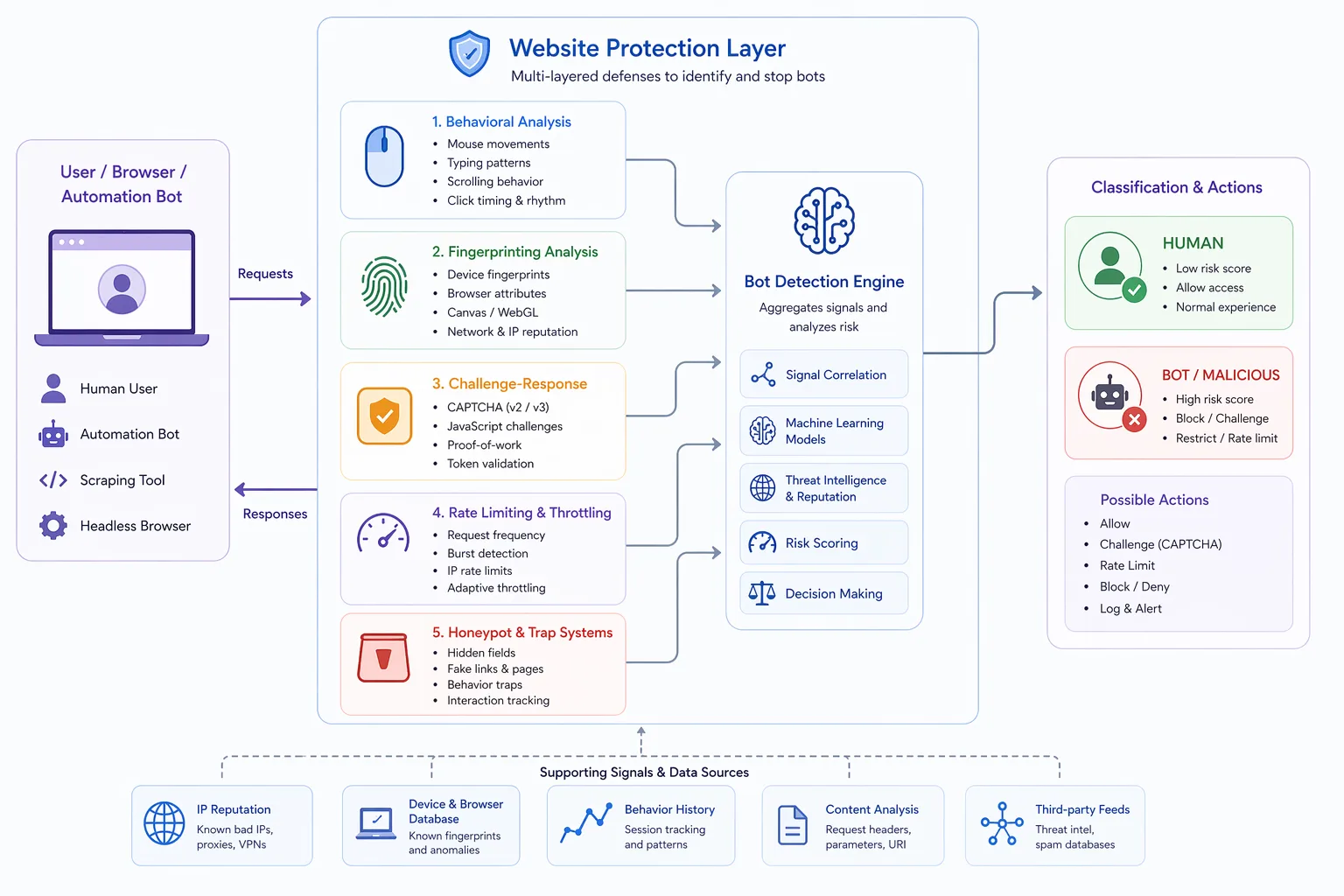
reCAPTCHA uses a combination of signals to determine whether a user is human.
Behavioral Analysis
The system analyzes how users interact with the page, including mouse movements, typing patterns, and timing.
Humans exhibit natural variability, while bots often produce consistent and predictable patterns.
Browser and Environment Signals
reCAPTCHA collects data about the browser and device, including properties exposed through JavaScript.
It checks for inconsistencies or signs of automation, such as missing features or modified APIs.
IP and Network Reputation
The system evaluates the reputation of the IP address. IPs associated with suspicious activity may receive lower trust scores.
Location consistency and request patterns are also considered.
Interaction History
reCAPTCHA benefits from Google’s broader ecosystem. It can use historical data and context to improve accuracy.
This allows it to identify patterns across sessions and platforms.
Why reCAPTCHA Matters
reCAPTCHA is widely used across the internet, making it one of the most common barriers for automation.
It helps protect websites from spam, abuse, and automated attacks while maintaining usability for real users.
For automation systems, reCAPTCHA represents a key challenge because it combines multiple detection methods.
Understanding how it works helps explain why certain interactions are flagged.
reCAPTCHA vs Traditional CAPTCHAs
Traditional CAPTCHAs rely on simple challenges, such as distorted text, to differentiate humans from bots.
reCAPTCHA goes beyond this by analyzing behavior and context. This makes it more accurate and less intrusive.
Instead of always requiring user input, it adapts based on risk level.
Limitations of reCAPTCHA
Despite its effectiveness, reCAPTCHA has limitations.
False positives can occur, where legitimate users are asked to complete challenges unnecessarily.
There is also the issue of accessibility, as some users may find challenges difficult to complete.
Additionally, as automation techniques evolve, detection systems must continuously improve.
reCAPTCHA vs Other Bot Detection Systems
reCAPTCHA is one component of a broader bot detection strategy.
While it focuses on user verification, other systems analyze network behavior, fingerprints, and session patterns.
Many websites combine reCAPTCHA with additional detection layers for stronger protection.
reCAPTCHA vs Real-Device Environments
A key distinction in modern detection is the difference between simulated behavior and natural behavior.
reCAPTCHA analyzes multiple signals, and inconsistencies in simulated environments can be detected even if individual signals appear correct.
Real-device approaches operate on actual hardware where behavior and signals naturally align. Tools like Appilot follow this approach by running automation on real Android devices, where browser interactions, network patterns, and device characteristics reflect real-world usage.
This reduces reliance on masking or simulation.
When reCAPTCHA Is Most Strict
reCAPTCHA becomes more strict in scenarios with higher risk, such as account creation, login attempts, and financial transactions.
In these cases, it may require additional verification steps to ensure security.
Understanding this helps in anticipating when challenges are likely to appear.
Frequently Asked Questions
Q: What is reCAPTCHA?
It is a bot detection system developed by Google to verify human users.
Q: How does reCAPTCHA work?
It analyzes behavior, browser data, and network signals to assign a risk score.
Q: What are the types of reCAPTCHA?
v2, v3, and Invisible reCAPTCHA.
Q: Why does reCAPTCHA show image challenges?
To verify that the user can recognize objects like a human.
Q: Can reCAPTCHA be avoided completely?
No, detection risk can be reduced but not eliminated.
Q: How do real-device solutions compare?
Real-device solutions like Appilot produce natural behavior and signals, reducing reliance on simulated environments.
Key Takeaways
reCAPTCHA is a Google-developed bot detection system that uses behavioral analysis, browser signals, and network data to distinguish humans from bots. It assigns a risk score to each interaction and adapts its response based on that score. While it improves security and user experience, it is not perfect and can sometimes challenge legitimate users. Understanding how reCAPTCHA works is essential for navigating modern web interactions and automation systems.