What Is WebRTC? (And Why It Leaks Your Real IP)

WebRTC is a powerful browser technology that enables real-time communication directly between devices. It is widely used for video calls, voice chats, and peer-to-peer data sharing in modern web applications. However, while it improves performance and reduces latency, it also introduces a critical privacy concern known as the WebRTC IP leak.
Understanding WebRTC is important because it can expose your real IP address even when you are using proxies or VPNs. This makes it highly relevant in environments where anonymity, automation, or geolocation consistency matters. This guide explains how WebRTC works and why it can reveal your real IP.
What Is WebRTC?
WebRTC, or Web Real-Time Communication, is a browser technology that allows direct communication between users without requiring a central server for data transfer.
It enables features such as video conferencing, voice calls, and file sharing directly within the browser.
Instead of routing all data through servers, WebRTC establishes peer-to-peer connections between devices, making communication faster and more efficient.
The Core Purpose of WebRTC
The primary purpose of WebRTC is to enable low-latency, real-time communication.
By connecting devices directly, it reduces delays and improves performance compared to traditional server-based communication.
This makes it ideal for applications like video calls and live streaming.
However, this direct connection is also what leads to IP exposure.
How WebRTC Works
WebRTC uses a combination of protocols and techniques to establish peer-to-peer connections.
ICE (Interactive Connectivity Establishment)
WebRTC uses ICE to discover the best path for communication between devices.
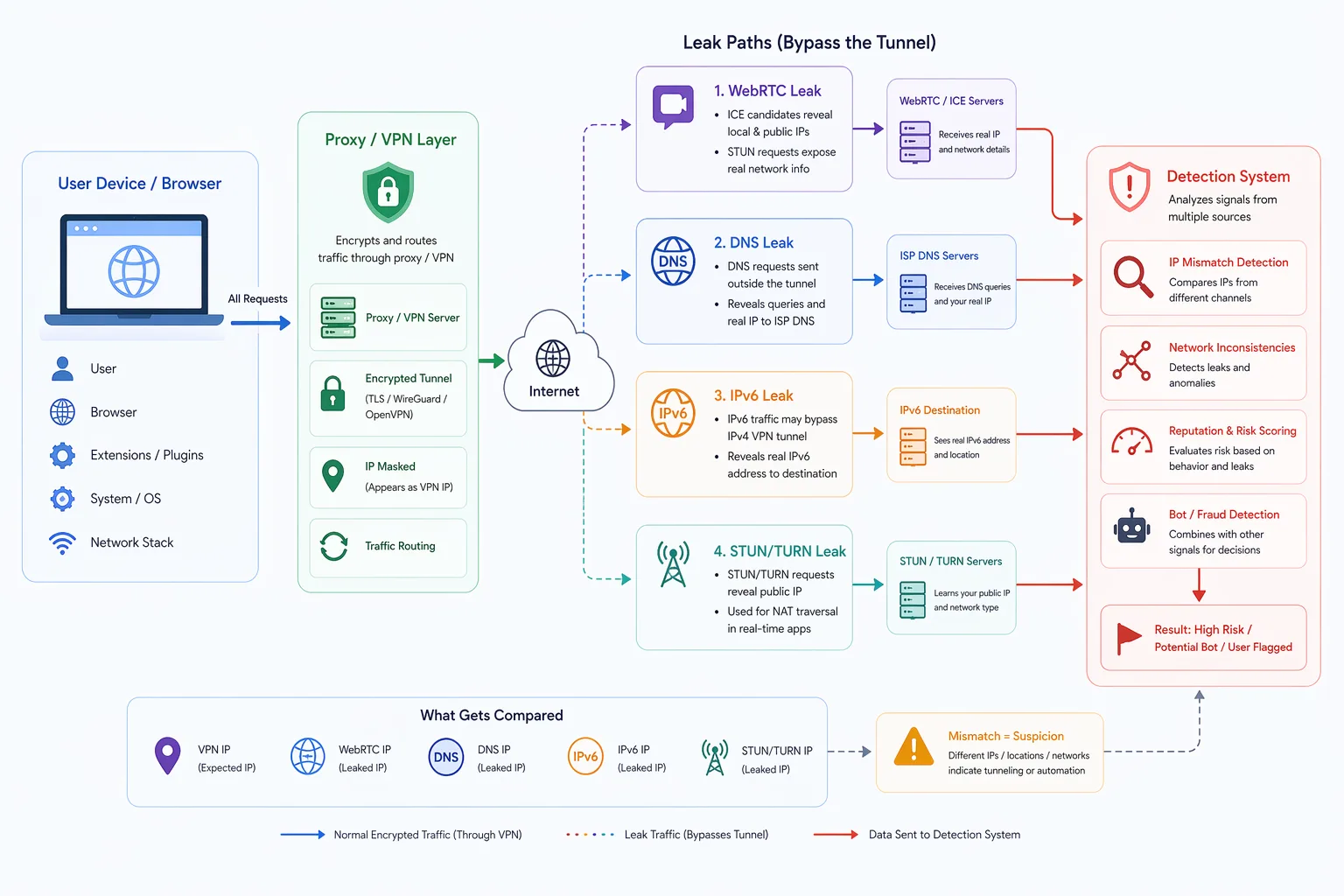
ICE gathers multiple network candidates, including local IP addresses and public IP addresses.
These candidates are then tested to determine the most efficient connection route.
STUN Servers
STUN (Session Traversal Utilities for NAT) servers help determine a device’s public IP address.
When a browser connects to a STUN server, it reveals the public-facing IP, even if a VPN or proxy is being used.
This is one of the main reasons WebRTC can leak real IPs.
TURN Servers
TURN (Traversal Using Relays around NAT) servers act as intermediaries when direct peer-to-peer connections are not possible.
They relay data between devices, but even in this case, IP information may still be exposed during the connection process.
What Is a WebRTC IP Leak?
A WebRTC IP leak occurs when your browser reveals your real IP address through WebRTC mechanisms, even if you are using a proxy or VPN.
This happens because WebRTC bypasses traditional network routing and directly queries network interfaces to establish connections.
As a result, both your local IP and your public IP can be exposed.
Why WebRTC Leaks Your Real IP
WebRTC leaks occur due to how ICE and STUN operate.
When gathering connection candidates, the browser collects all available IP addresses, including those not routed through your proxy or VPN.
These addresses can then be accessed by websites through JavaScript, exposing your real network information.
This behavior is built into how WebRTC functions and is not considered a bug.
Why WebRTC Leaks Matter
WebRTC leaks are important because they can compromise anonymity and consistency.
Even if your traffic is routed through a proxy or VPN, a WebRTC leak can reveal your actual location.
This creates mismatches between your visible IP and your real IP, which can be detected by websites.
Such inconsistencies are often used in bot detection and fraud prevention systems.
WebRTC and Browser Fingerprinting
WebRTC contributes to browser fingerprinting by exposing network-related information.
The combination of local IP, public IP, and connection behavior can be used to uniquely identify users.
This adds another layer of tracking beyond cookies and traditional methods.
Websites can use this data to correlate sessions and detect anomalies.
WebRTC vs Proxies and VPNs
Proxies and VPNs route traffic through external servers to mask your IP address.
However, WebRTC operates at the browser level and can bypass these routes when gathering connection data.
This means that even if your main traffic is protected, WebRTC can still expose your real IP.
This creates a gap between expected and actual network behavior.
How Websites Detect WebRTC Leaks
Websites use JavaScript to access WebRTC APIs and retrieve IP candidates.
They compare the detected IP addresses with the IP seen from the request.
If there is a mismatch, it can indicate the presence of a proxy, VPN, or automation setup.
This is commonly used in bot detection systems.
Limitations of WebRTC Detection
While WebRTC leaks are a strong signal, they are not always present.
Some browsers restrict access to certain IP information.
Users can also disable WebRTC or use configurations that limit exposure.
However, relying solely on WebRTC detection is not sufficient, so it is often combined with other signals.
WebRTC vs Real-Device Environments
A key distinction in modern detection is the difference between simulated setups and real-device environments.
WebRTC leaks often create inconsistencies in environments where network routing is artificially modified.
Real-device approaches operate on actual hardware and network conditions where signals align naturally. Tools like Appilot follow this approach by running automation on real Android devices, where network behavior, IP exposure, and browser execution are consistent with real-world usage.
This reduces mismatches that detection systems look for.
When WebRTC Leaks Are Most Critical
WebRTC leaks are most critical in scenarios where IP consistency is important.
This includes account management, geo-restricted services, and high-security platforms.
In these contexts, mismatched IP data can lead to detection or restrictions.
Understanding this helps in identifying potential risks.
Frequently Asked Questions
Q: What is WebRTC?
It is a browser technology that enables real-time peer-to-peer communication.
Q: What is a WebRTC IP leak?
It is when your real IP is exposed through WebRTC despite using a proxy or VPN.
Q: Why does WebRTC leak IP addresses?
Because it gathers all available network candidates for connection setup.
Q: Can WebRTC leaks be prevented?
They can be reduced by disabling WebRTC or adjusting browser settings.
Q: Do all browsers leak IP through WebRTC?
Most modern browsers support WebRTC, but behavior may vary.
Q: How do real-device solutions compare?
Real-device solutions like Appilot maintain consistent network behavior, reducing mismatches caused by WebRTC leaks.
Key Takeaways
WebRTC is a browser technology that enables real-time communication through peer-to-peer connections. While it improves performance, it can expose your real IP address through mechanisms like ICE and STUN, even when using proxies or VPNs. This creates inconsistencies that can be detected by websites and used in bot detection systems. Understanding how WebRTC works and its impact on privacy is essential for managing modern web interactions.