Why Instagram Bots Get Shadowbanned (Mobile-Specific Issues)
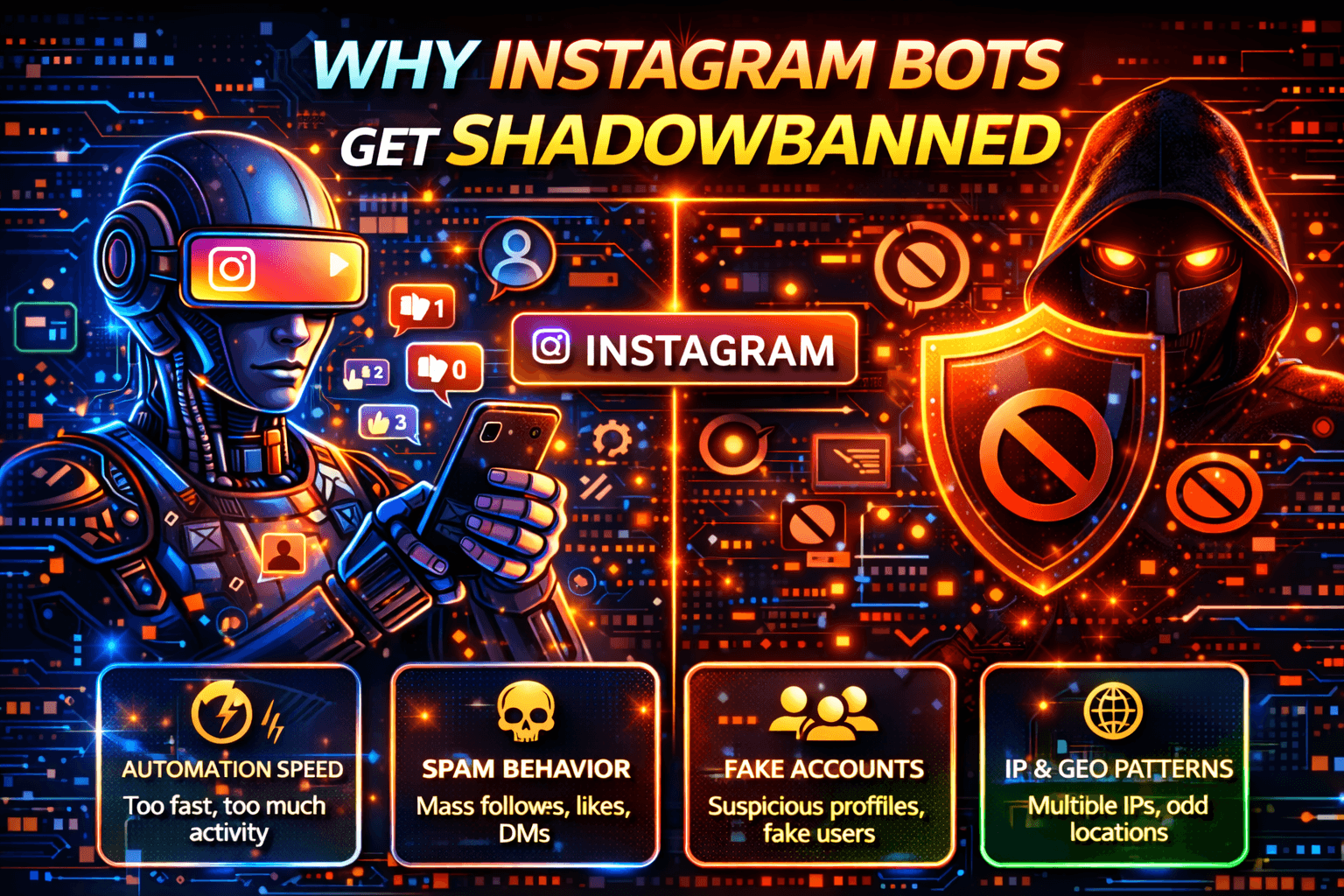
Your Instagram bot is running. There are no visible errors, no action blocks, and no warnings. Yet reach suddenly dies, hashtags stop ranking, Reels lose discovery traffic, and engagement collapses.
That is not a bug. That is a shadowbanned Instagram bot.
Shadowbans are one of the most dangerous forms of restriction because everything appears normal on the surface. For bots, especially mobile-based ones, shadowbanning is usually caused by how the automation behaves rather than what it does.
Why Shadowbanning Is Instagram’s Favorite Weapon
Instagram rarely moves directly to hard bans anymore. Instead, it prefers shadowbanning because it is quiet, algorithmic, low-friction, and difficult to prove.
For Instagram, shadowbanning creates less backlash, lowers support overhead, and reduces the visibility of spammy or suspicious content without requiring direct enforcement actions.
For users and automation operators, the effect is much worse because campaigns silently fail, clients blame the content itself, and bots continue to appear functional even though they are producing no real results.
In 2026, silent suppression is much more common than outright account bans.
What a Shadowbanned Bot Actually Looks Like
A shadowbanned setup usually looks deceptively normal. Posts stop ranking in hashtags, Reels lose Explore visibility, comments no longer surface prominently, and follows succeed without converting into meaningful engagement.
There is also rarely an official warning from Instagram. Shadowbans are based on algorithmic suppression rather than direct account restrictions, which is why they are so difficult to diagnose.
Why Instagram Bots Get Shadowbanned
1. “Mobile” Automation That Isn’t Truly Mobile
Many automation systems claim to be mobile even though they rely on emulators, desktop-controlled Android instances, or simulated sensor environments.
Instagram can often detect missing accelerometer data, synthetic GPS behavior, inconsistent device telemetry, and common emulator artifacts. A fake mobile environment may look like a phone on the surface, but underneath it still behaves like a synthetic system.
That mismatch between appearance and reality is one of the biggest shadowban triggers.
2. Repetitive Interaction Patterns
Instagram monitors mobile-specific behavior such as scroll velocity, pause timing, tap rhythm, and overall session structure.
Bots often scroll at constant speeds, tap at perfect intervals, and repeat identical flows across multiple sessions. Humans do not behave that way. Real users are inconsistent, distracted, and unpredictable.
Perfect efficiency is suspicious because it signals automation rather than human interaction.
3. Over-Clean Sessions
Real users hesitate, open Stories, switch between apps, scroll randomly, and waste time doing things that are not directly related to a goal.
Bots usually do the opposite. They perform only goal-oriented actions, never wander around the app, never misclick, and never idle.
Ironically, being too optimized increases shadowban risk because the session becomes unnaturally clean and efficient.
4. Cross-Account Behavioral Cloning
If multiple accounts act at the same time, follow the same patterns, and use identical automation logic, Instagram can correlate them.
One suppressed account can quietly influence the trust score of other accounts that behave similarly. Shadowbanning often spreads across groups of accounts because of behavioral similarity rather than because of IP addresses alone.
Why Action Limits Aren’t the Real Problem
Shadowbans are not mainly about exceeding action limits. They are mostly about confidence scoring.
Instagram evaluates device authenticity, behavioral variance, session realism, and account history. You can stay well below traditional follow, like, or comment limits and still get shadowbanned if the overall session looks unnatural.
This is why many “safe limits” guides fail. Limits alone do not create trust.
Why Traditional Fixes Don’t Work
Fix #1: Rotating Proxies
Rotating IP addresses can help slightly, but shadowbans are mostly driven by behavioral, device-level, and session-based signals.
Changing IPs without changing how the automation behaves usually does very little to restore trust.
Fix #2: Switching to Emulators
Emulators do not provide real sensor signals, authentic hardware telemetry, or natural performance variance.
Instagram can detect common emulator patterns relatively easily, which means mobile UI automation alone does not equal mobile authenticity.
Fix #3: Slowing Down Automation
Simply adding fixed delays does not make a bot look human. Humans are inconsistent, while fixed delays create even more predictable patterns.
A slower bot is still a bot if it behaves in the same repetitive way every time.
Fix #4: Creating New Accounts
If the behavior, environment, and automation model remain unchanged, new accounts get suppressed quickly as well.
The problem is rarely the account itself. The real problem is the execution model behind it.
The Real Fix: Human-Like Mobile Sessions
To reduce the risk of shadowbanning, automation needs to run on real devices, produce authentic device signals, introduce behavioral variance, ramp activity gradually, and avoid synchronization across accounts.
There are generally two ways to approach this.
Two Ways to Prevent Instagram Shadowbanning
1. DIY Mobile Automation
A do-it-yourself approach usually involves physical Android devices, UI automation frameworks, and custom behavior logic.
The main advantage is full control over how the system behaves. However, it is difficult to scale, expensive to maintain, and often fragile when Instagram updates the app.
2. Managed Mobile Automation
Platforms like Appilot execute automation directly on real Android devices with isolated sessions and more human-like interaction models.
Because Appilot relies on real devices, Android Accessibility Services, and mobile-first execution rather than browser-based automation or emulator-heavy setups, it reduces many of the signals that commonly trigger Instagram shadowbanning.
No platform can completely eliminate suppression risk, but combining authentic environments with realistic behavior dramatically improves long-term stability.
Step-by-Step: Fixing a Shadowbanned Bot
Step 1: Pause Automation
Pause all automation for 24 to 72 hours so the account can cool down and suppression pressure can begin to drop.
Step 2: Change Behavior — Not Just Settings
If you resume automation using the exact same logic, the suppression will continue.
Instead of tweaking minor settings, redesign the entire session flow and interaction style.
Step 3: Add “Wasted Time”
Introduce story viewing, idle scrolling, random pauses, and non-goal-oriented actions into the session flow.
This wasted time makes the account appear more realistic because humans do not spend every second acting with perfect efficiency.
Step 4: Reduce Uniformity
Every account should run at different times, behave differently, and follow different engagement patterns.
Uniformity is one of the strongest indicators of automation.
Step 5: Ramp Slowly
Start with low activity levels and gradually increase them over two to three weeks.
Aggressive scaling immediately after recovery often triggers suppression again.
Real Example
A marketer running 15 Instagram bots noticed there was no hashtag reach, engagement stayed flat, and there were no visible warnings from Instagram.
The root cause was identical mobile automation flows, no idle behavior, and heavily synchronized timing across all accounts.
After introducing more behavioral diversity, desynchronized schedules, and real-device execution, engagement slowly returned over the following weeks.
Shadowbans are fundamentally behavioral rather than mechanical.
Common Mistakes
Scaling immediately after recovery often re-triggers suppression because the account has not regained trust yet.
Overcorrecting by only adding delays is also ineffective because slower bots are still bots.
Finally, assuming that mobile automation is automatically safe is a mistake. Authenticity matters more than simply being on a mobile device.
Long-Term Strategy
To build shadowban-resistant automation, you need to design for realism rather than efficiency.
Each account should behave like a unique user with different habits, different schedules, and different engagement patterns. It is also important to track reach and discovery performance instead of focusing only on successful actions.
Instagram’s detection systems will continue evolving, so automation systems must evolve alongside them.
Shadowbans usually disappear when Instagram regains trust in the authenticity of the session.
FAQs
Q1: How long does a shadowban last?
A shadowban can last anywhere from a few days to several weeks depending on how much the behavior changes after suppression begins.
Q2: Can mobile bots get shadowbanned?
Yes. Simply being mobile is not enough. If the device signals, behavior, or session structure still appear synthetic, Instagram can still suppress the account.
Q3: Do proxies fix shadowbans?
Only slightly. Proxies may help with IP diversity, but behavioral and device-level trust signals matter much more.
Q4: Is shadowbanning permanent?
Usually not. However, repeated offenses and repeated suppression cycles can extend how long the account remains limited.
Conclusion
If your Instagram bot is shadowbanned, it is not necessarily broken. It is more likely distrusted.
Shadowbans are usually caused by inauthentic device signals, repetitive interaction patterns, and over-optimized automation flows.
The fix is not just changing proxies or slowing things down. You need to improve both the environment and the behavior behind the automation.
Run automation on real devices, create more human-like sessions, avoid synchronization, and scale gradually.
If your automation behaves like a real human, Instagram is far less likely to quietly suppress it.