Why You're Scared to Let Anyone Help with Your Accounts

Many people know they need help managing their accounts, but they still avoid giving anyone access. They keep doing everything themselves because they are afraid someone will make mistakes, lose passwords, change settings, use the wrong browser profile, or accidentally damage an important account.
That fear is understandable because once an account gets mixed up, restricted, or lost, fixing the problem can take a lot of time. If you manage client accounts, advertising accounts, browser profiles, ecommerce stores, or social media pages, the risk feels even higher.
The problem is that trying to do everything alone eventually becomes overwhelming. You spend too much time switching between accounts, checking passwords, opening browser profiles, updating notes, and handling repetitive tasks that someone else could help with.
For agencies, affiliate marketers, ecommerce teams, outreach teams, and social media managers, refusing to delegate often becomes one of the biggest reasons growth slows down.
The issue is usually not that people cannot be trusted. The issue is that there is no system that makes delegation feel safe.
Once you have proper permissions, organized browser profiles, centralized credentials, and clear ownership rules, it becomes much easier to let other people help without losing control.
In this guide, you will learn why delegating account access feels risky, what mistakes make it worse, and how to safely let people help with your accounts.
Time to improve: Usually between one and three days depending on team size. Success rate: High if permissions and workflows become more structured. Cost: Usually low compared to the amount of time it saves.
Why Letting Other People Help Feels Risky
Most people are not afraid of delegation itself. They are afraid of losing control.
They worry that someone will log into the wrong account, use the wrong proxy, forget a password, change an important setting, delete something, or get an account flagged.
These fears become even stronger when browser profiles, passwords, notes, proxies, and account ownership are not organized properly.
If everything is spread across spreadsheets, chat messages, folders, and bookmarks, then giving someone access feels dangerous because there is no clear system behind it.
The larger the operation becomes, the harder it becomes to manage everything alone.
The Hidden Cost of Not Delegating
Trying to do everything yourself wastes more than time because it also slows down growth. You spend hours handling small repetitive tasks that could easily be assigned to someone else.
You may spend your day opening browser profiles, updating passwords, checking notes, switching between tabs, assigning proxies, and monitoring account status.
That leaves very little time for strategy, client communication, campaign planning, and business growth.
Eventually, the operation becomes too large for one person to manage properly.
The Most Common Delegation Mistakes
One of the biggest mistakes is giving people full access to everything. If every team member can see every browser profile, password, proxy, and account, mistakes become much more likely.
Another common issue is unclear ownership. If nobody knows who is responsible for an account, it becomes much easier for people to use the wrong profile or make conflicting changes.
Poor browser profile naming is another major problem because if profiles are called things like "Profile 7" or "Test Browser," nobody knows what they belong to.
Another common mistake is storing passwords, notes, proxies, and browser profile details in different places.
How to Delegate Account Access Safely
Step 1: Separate Access by Role
Not everyone needs access to everything. Team members should only see the browser profiles, passwords, notes, and accounts they actually need for their role. This reduces confusion and lowers the risk of mistakes.
Step 2: Use Clear Naming Systems
Every browser profile, account, folder, and proxy should follow the same naming structure. The more consistent the naming system becomes, the easier it becomes for people to know what belongs where.
Step 3: Keep Credentials Organized
Passwords, recovery emails, phone numbers, backup codes, proxies, and notes should stay in one secure place. The more centralized the information becomes, the easier it becomes to give limited access without losing control.
Step 4: Assign Ownership Clearly
Every browser profile and account should have a clear owner. Even if multiple people work on the same project, there should always be one main person responsible for updates, recovery, and account activity.
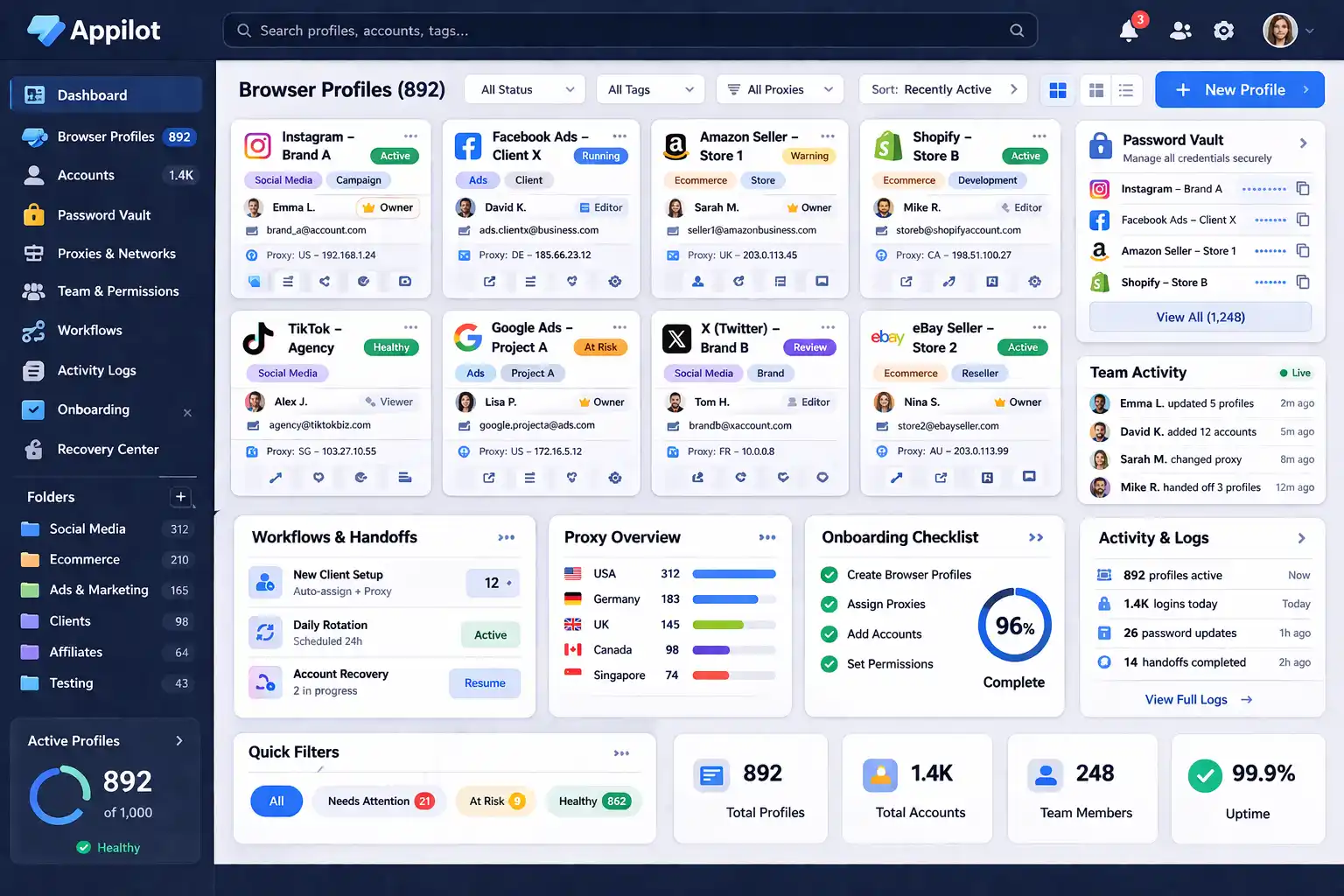
Step 5: Track Activity Clearly
You should always know who accessed an account, what changes were made, and when activity happened. Activity logs make it much easier to understand what is happening across the operation.
Step 6: Reduce Manual Work
The more manual the process becomes, the harder it becomes to delegate safely. Appilot can help reduce confusion by making browser profiles, permissions, credentials, account assignments, and workflows easier to organize and manage.
Step 7: Build Team Rules
Everyone on the team should know how browser profiles should be named, where credentials should be stored, what actions are allowed, and who owns each account. The more consistent the process becomes, the easier it becomes to delegate work safely.
How to Prevent Delegation Problems in the Future
The best way to make delegation safer is building structure before the operation becomes too large. Use clear naming systems, centralized credential storage, separate permissions, activity logs, and ownership tracking.
Avoid shared passwords, random browser profile names, unclear ownership, and giving everyone access to everything. The more organized the system becomes, the easier it becomes to trust other people with your accounts.
Common Mistakes That Make Delegation Feel Riskier
One major mistake is giving full access to every team member. Another mistake is failing to organize passwords, browser profiles, and notes in one place.
People also make the mistake of not tracking ownership and activity. Without a clear system, it becomes much harder to know who did what.
Another common issue is waiting too long to build a safer delegation process.
Frequently Asked Questions
Q1: Why does it feel risky to let other people help with accounts?
Because people worry about mistakes, lost passwords, wrong browser profiles, and account restrictions.
Q2: What is the safest way to delegate account access?
Use separate permissions, clear ownership rules, centralized credential storage, and activity logs.
Q3: Should every team member have full access?
No. Team members should only have access to the accounts and browser profiles they actually need.
Q4: How do you stop people from using the wrong account?
Use organized browser profile names, separate folders, ownership rules, and permissions.
Q5: Does Appilot help make delegation safer?
Appilot helps make permissions, browser profile organization, activity tracking, and account assignments much easier.
Conclusion
Being afraid to let other people help with your accounts is understandable, especially when the operation is large and mistakes can be expensive.
The problem is that trying to do everything alone eventually becomes overwhelming.
Once you organize browser profiles properly, centralize credentials, assign ownership, and create separate permissions, it becomes much easier to let people help without losing control.
The goal is not just giving people access. The goal is building a system that makes delegation feel safe.